
A spotting scope is a high-precision monocular telescope specifically designed for observing bullet impact points on targets during shooting training and competitions.
Spotting scopes are designed for professional and demanding shooting environments, and therefore possess a series of unique characteristics:
1. Extremely high resolution and sharpness: This is the essence of a spotting scope. Its core objective is to clearly distinguish bullet holes only a few millimeters in diameter on a distant target, as well as subtle differences between the bullet holes. Ultimate optical sharpness is the primary goal.
2. Robust and durable body: This is the most crucial difference. Shooting ranges, especially near large-caliber rifles, generate strong shock waves and vibrations. The spotting scope's body and internal optical structure are specially reinforced to withstand these repeated impacts without causing optical axis misalignment or loosening of parts. Ordinary telescopes are easily damaged by vibrations when placed near a gun.
3. Special focusing system:
* Side focusing: The focusing ring is located on the side of the scope body, making it easy to operate and less prone to accidental adjustments.
* Objective lens focusing: This is a signature feature of spotting scopes. Focusing is achieved by rotating the objective lens end, the advantage being that it can accurately compensate for bullet drop at different distances. The scale on the focusing ring directly corresponds to the shooting distance, allowing the shooter to quickly set the focus.
4. Large magnification range: Spotting scopes typically have a large zoom range, such as 25-60x, or even higher. Low magnification is used to locate the target, and high magnification is used for precise observation of bullet holes.
5. Excellent distortion control: To accurately determine the position of bullet holes, the image at the edge of the field of view must also be clear and free from significant distortion.
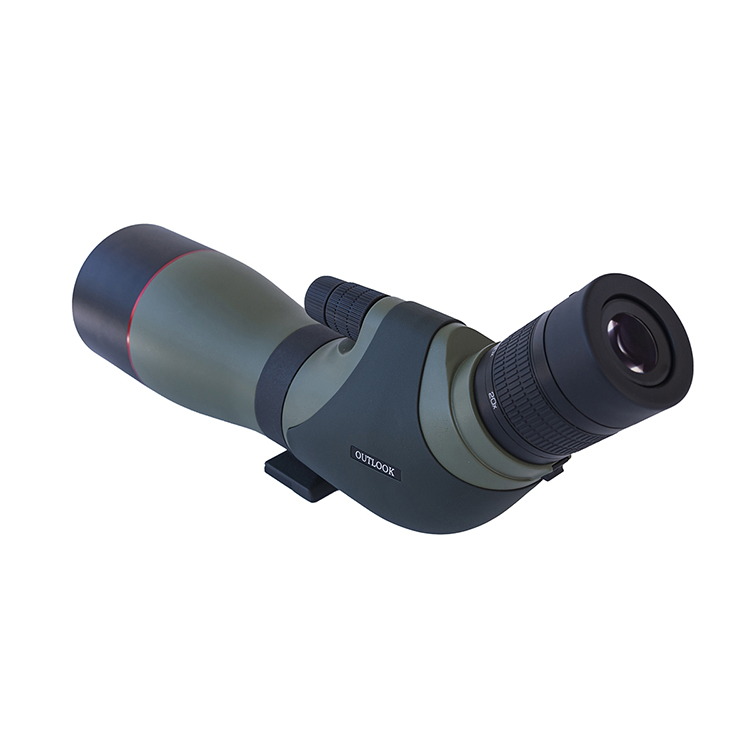
Typical appearance characteristics of a spotting scope:
* Large objective lens: The objective lens diameter is usually large (80mm, 90mm) to ensure sufficient light gathering and image brightness at high magnification.
* Focusing ring at the objective lens end: Usually features many fine distance markings.
* Large tripod mount: Requires a very stable tripod support. Spotting scopes are almost without exception monocular, and the reason for this monocular design is primarily determined by its core purpose:
**Extreme stability requirements:
** Spotting scopes require very high magnification (such as 40x, 60x, or even higher). At such high magnification, even the slightest hand tremor when handheld will be magnified to the point where the target becomes impossible to see clearly. The monocular design allows for very stable mounting on a tripod, completely eliminating the effects of hand tremor. If it were made into a binocular design, not only would the structure be more complex, but the weight and volume would increase dramatically, and it would be difficult to ensure that the optical axes of the two tubes remain perfectly parallel under vibration, affecting observation.
**Dedicated observation scenario:
** Its purpose is to observe a fixed target paper; the target itself is stationary. There is no need to pursue a wide field of view and portability to track moving targets like handheld binoculars. The shooter or spotter can comfortably and for extended periods perform detailed observation with one eye.
**Optimization of cost and precision:
** To achieve the same optical performance and robustness as a high-quality monocular spotting scope in a binocular design, the cost, weight, and volume would become very impractical. The monocular design is the most reasonable and economical choice while ensuring the highest optical precision and durability.
**Birdwatching monocular scopes and spotting scopes share very similar core optical principles, but their design focus, functional details, and applicable scenarios are significantly different and cannot be considered entirely equivalent.**
You can understand them as two tools with "the same origin but different purposes."
Core Similarities of Birdwatching Monocular Scopes and Spotting Scopes
* Optical Structure: The vast majority of spotting scopes and birdwatching monocular scopes are monocular telescopes, using refractive or catadioptric optical systems to provide high magnification.
* Basic Function: Both of spotting scopes and birdwatching monocular scopes can be used for long-distance observation and usually require a tripod for stability.
Can the spotting scopes and birdwatching monocular scope be used interchangeably?
In some cases, yes, but with limitations:
* Using a spotting scope for birdwatching:
* Advantages: Extremely high optical sharpness, allowing for detailed viewing of feathers.
* Disadvantages: Too heavy and bulky, inconvenient to carry; the focusing system may not be as fast and flexible as a spotting scope, making it difficult to track flying birds; the colors may be yellowish or not vibrant enough.
* Using a birdwatching monocular scope for target shooting:
* Advantages: Can be used temporarily in low-recoil environments (such as air guns, small-caliber rifles).
* Disadvantages: Very dangerous! Birdwatching monocular scopes are not designed to withstand strong shock waves. Placing them next to a large-caliber rifle is likely to damage the optical components (prism displacement, adhesive failure, etc.). Their focusing system may also not provide the extreme precision required for target shooting.
Summary
You can understand it this way:
* A birdwatching monocular scope is a lightweight, agile "field ecologist/photographer."
* A spotting scope is a sturdy, reliable, and highly precise "engineering surveyor."
Conclusion: If your main purpose is birdwatching or nature observation, please choose a birdwatching monocular scope. If you are a shooting enthusiast and need to observe bullet impact points, for the safety of your equipment and yourself, please be sure to choose a professional spotting scope.
scope scope scope scope scope scope
